
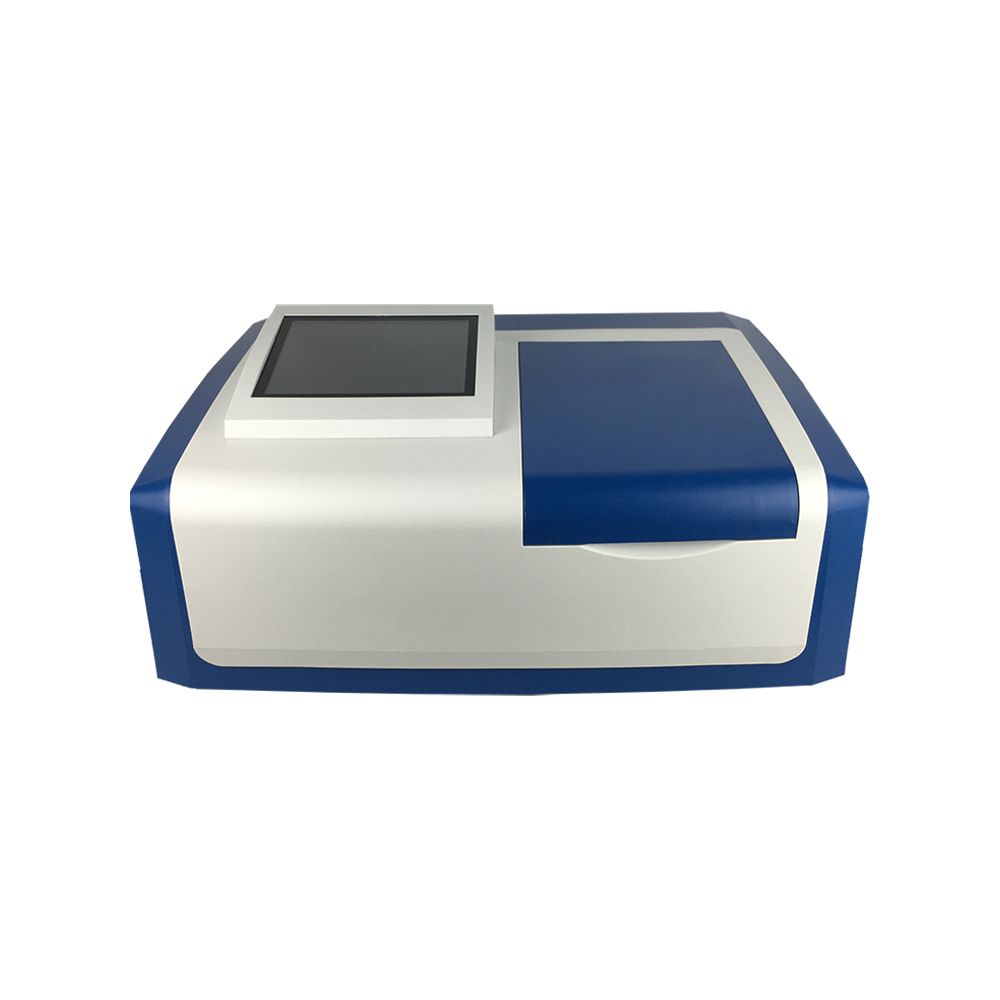
Double Beam UV VIS Spectrophotometer TRDUV-603
Website: www.labotimes.com
Email: info@labotimes.com
Double Beam UV VIS Spectrophotometer TRDUV-603 is a small device that measures multiple wavelengths with a bandwidth of 1.8 nm and a wavelength range of 190 to 1100 nm. Blazed holographic gratings with a photometric accuracy of 0.3 % T (0 to 100 % T), 0.002A (0 to 0.5A), 0.004A (0.5A to 1A). Has an 8-inch touchscreen for ease of operating and parameter observing, and it has a Photometric Display Range of 0.0 to 200.0 % T, -0.301 to 4.000 A, 0.000 to 9999 C. It performs admirably in both qualitative and quantitative testing.
| Monochromatic type | Czerny turner |
| Focal length | 160 mm |
| Wavelength Range | 190 to 1100 nm |
| Band Width | 1.8 nm |
| Wavelength Accuracy | ±0.3 nm |
| Wavelength Repeatability | ≤0.01 nm |
| Photometric Display Range | 0.0 to 200 .0% T , -0.301 to 4.000 A , 0.000 to 9999 C |
| Photometric Accuracy | ±0.3% T(0 to 100%T) / ±0.002A(0 to 0.5A) / ±0.004A(0.5A to1A) |
| Photometric Repeatability | 0.15% T(0 to 100%T) / ±0.001A(0 to 0.5A) / ±0.002A(0.5A to 1A) |
| Photometric Mode | T,A,C,E |
| Stray Light | ≤0.03% τ (220nm NaI, 360 nm NaNO2) |
| Stability | 0.0005A/h500 nm |
| Detector | Import Silicon Photodiode |
| Scanning speed | Fast-medium-slow |
| Power Requirement | AC 220 V±22 50 Hz±1 Hz,200 W |
| Baseline Flatness | ≤0.002A(200 to1090 nm) |
| Grating | 1200 lines/mm |
| Drifting | ≤0.0009 Abs/30 min |
| Noise | 100 % (T)≤0.15 % (T); 0 % (T)≤0.1 % (T) |
| Dimensions(W×D×H) | 74×63×45 Cm |
| Weight | 35 Kg |
It is to determine the amount of light of a specific wavelength absorbed by an analyte in a sample. Although samples can be gases or liquids, an analyte dissolved in a solvent is discussed here.
 Enquiry


